


I. What Is LSAW Steel Pipe? What Are Its Key Characteristics?
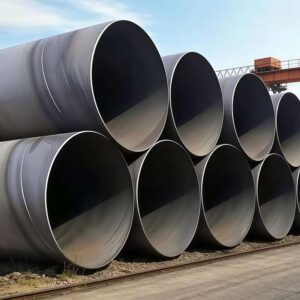
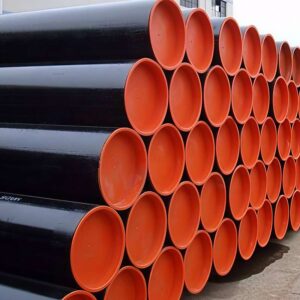
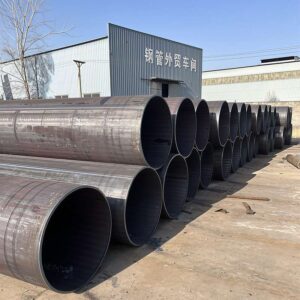
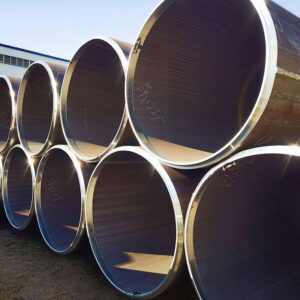
LSAW steel pipe (Longitudinal Submerged Arc Welded Steel Pipe) is a type of welded steel pipe manufactured from steel plates. The steel plate is formed into a cylindrical shape using forming equipment and then welded along its length using the longitudinal submerged arc welding (SAW) process.
LSAW steel pipes have the following key characteristics:
1. Wide Range of Available Dimensions: Different outside diameters and wall thicknesses can be selected according to project requirements.
2. Suitable for Heavy-Wall Applications: Steel plate raw materials are available in different thicknesses to meet the manufacturing requirements of various pipe specifications.
3. Flexible Material Selection: Different carbon steel grades can be selected to meet specific project requirements.
4. Inspectable Weld Quality: Non-destructive testing methods, such as ultrasonic testing (UT) and radiographic testing (RT), can be performed in accordance with applicable product standards and project requirements.
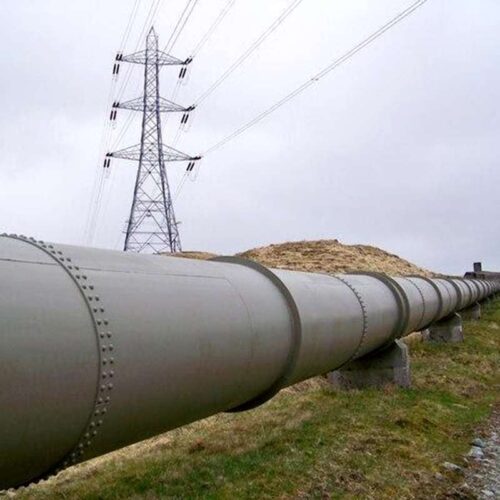
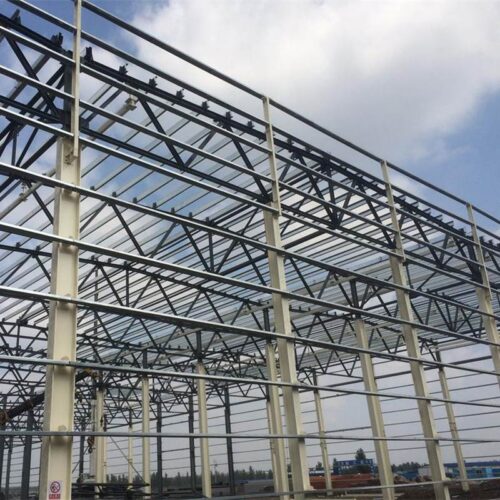
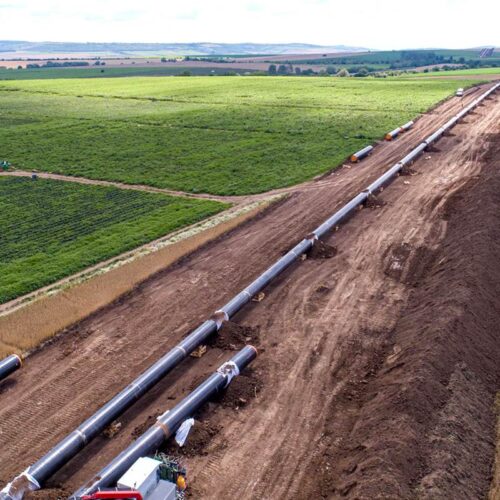
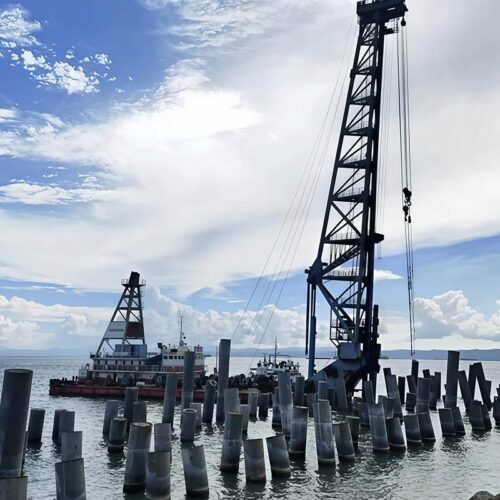
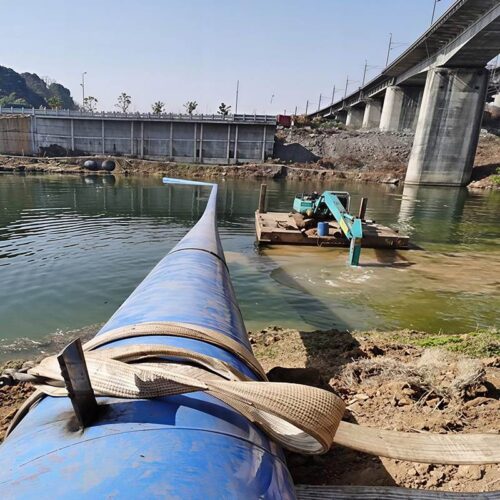
5. Suitable for Various Engineering Applications: These include oil and gas transmission, industrial piping systems, water transmission projects, steel pipe piling, and structural engineering.
It should be noted that the actual specification range of LSAW steel pipes depends on the production equipment, manufacturing processes, and applicable product standards. The manufacturing capabilities of an individual manufacturer should not be regarded as a universal specification range for the entire industry.
II. Table of Common Outer Diameters and Wall Thicknesses for LSAW Steel Pipes
| NPS | OD (mm) |
WT (mm) |
| 16″ | 406.4 | 6–20 |
| 18″ | 457.2 | 6–22 |
| 20″ | 508.0 | 6–25 |
| 22″ | 558.8 | 6–25 |
| 24″ | 609.6 | 8–30 |
| 26″ | 660.4 | 8–30 |
| 28″ | 711.2 | 8–32 |
| 30″ | 762.0 | 8–35 |
| 32″ | 812.8 | 8–35 |
| 34″ | 863.6 | 8–35 |
| 36″ | 914.4 | 8–40 |
| 40″ | 1016.0 | 10–40 |
| 42″ | 1066.8 | 10–40 |
| 44″ | 1117.6 | 10–40 |
| 48″ | 1219.2 | 10–45 |
| 52″ | 1320.8 | 12–50 |
| 56″ | 1422.4 | 12–50 |
| 60″ | 1524.0 | 12–50 |
| 64″ | 1625.6 | 12–50 |
III. Common LSAW Steel Pipe Standards and Grades
| Standard | Common Steel Grades |
| API 5L | Grade A25, Grade A, Grade B, X42, X46, X52, X56, X60, X65, X70, X80 |
| ASTM A252 | Grade 1, Grade 2, Grade 3 |
| ASTM A139 | Grade A, Grade B, Grade C, Grade D, Grade E |
| ASTM A671 | CA55, CB60, CB65, CC60, CC65, CC70 |
| ASTM A672 | A45, A50, B60, C55, C60, C65, C70, D80 |
| EN 10219 | S235JRH, S275J0H, S275J2H, S355J0H, S355J2H, S355K2H |
| EN 10210 | S235JRH, S275J0H, S275J2H, S355J0H, S355J2H, S355K2H |
| GB/T 9711 | L175, L210, L245, L290, L320, L360, L390, L415, L450, L485, L555 |
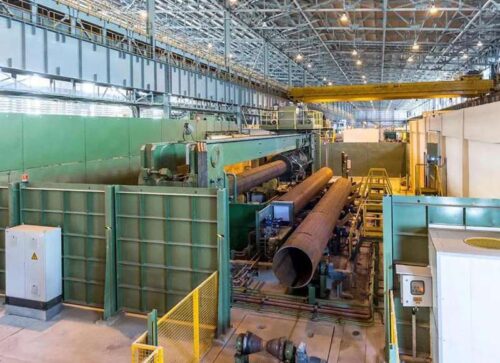
IV. Main Manufacturing Process for LSAW Steel Pipes
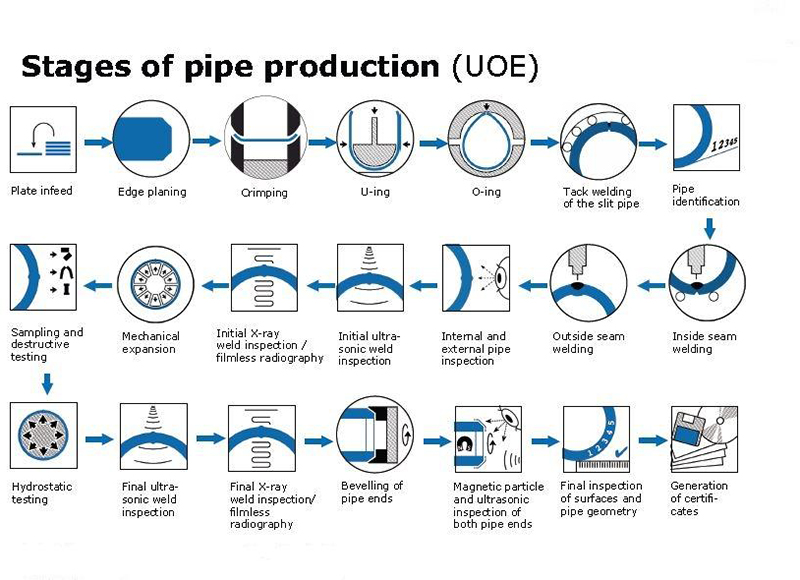
Steel Plate Inspection → Edge Milling → Pre-bending → JCO Forming → Tack Welding → Internal SAW → External SAW → Weld Inspection → Mechanical Expanding → Hydrostatic Testing → Final Inspection & Marking
What Are the Differences Between JCOE and UOE Forming Processes?
JCOE and UOE are both commonly used forming processes for LSAW steel pipes. However, they differ in how the steel plate is formed and in the structure of the forming equipment.
| Comparison Item | JCOE | UOE |
|---|---|---|
| Forming Method | Multi-step incremental pressing | U-forming followed by O-forming |
| Main Equipment | Hydraulic forming press | U-forming and O-forming equipment |
| Production Characteristics | Flexible forming process | Relatively concentrated forming stages |
| Specification Adjustment | Adjusted through changes in dies and pressing parameters | Depends on equipment and die configurations |
| Applicable Range | Large-diameter, heavy-wall pipes and a wide range of specifications | Large-diameter and heavy-wall pipes |
Both processes can produce high-quality LSAW steel pipes, and neither can be considered universally superior to the other. Actual product quality depends on equipment capabilities, process control, welding quality, and the inspection system.
Key Quality Control Points in LSAW Steel Pipe Production
| Production Stage | Key Quality Control Points |
|---|---|
| Raw Material Inspection | Steel grade, chemical composition, and mechanical properties |
| Steel Plate Forming | Roundness, forming dimensions, and edge alignment |
| Welding Process | Welding parameters, fusion quality, and weld seam formation |
| Non-Destructive Testing (NDT) | Internal and surface weld defects |
| Mechanical Expansion | Outside diameter, roundness, and dimensional tolerances |
| Hydrostatic Testing | Test pressure, pressure holding, and leakage inspection |
| Final Inspection | Appearance, dimensions, pipe ends, and marking |
V. LSAW Steel Pipe Inspection and Testing Standards
| Inspection Item | Inspection Details | Reference Standards |
|---|---|---|
| Chemical Composition | Chemical analysis of elements such as C, Mn, Si, P, and S | API 5L / ISO 3183 |
| Tensile Test | Tensile strength, yield strength, and elongation after fracture | API 5L / ISO 3183 / ASTM A370 |
| Impact Test | Charpy V-notch impact test to evaluate material toughness at low temperatures, where applicable | API 5L / ISO 3183 / ASTM A370 |
| Hardness Test | Hardness testing of the base metal, weld seam, and heat-affected zone (HAZ), where applicable | API 5L / ISO 3183 / ASTM E10 / ASTM E18 |
| Ultrasonic Testing (UT) | Ultrasonic examination to detect internal defects in weld seams and specified areas | API 5L / ISO 3183 / ISO 10893-11 |
| Radiographic Testing (RT) | Radiographic examination to detect internal weld defects, as required | API 5L / ISO 3183 / ISO 17636 |
| Magnetic Particle Testing (MT) | Magnetic particle examination to detect surface and near-surface defects, where applicable | ASTM E709 / ISO 9934-1 |
| Hydrostatic Test | Hydrostatic testing to verify the pressure resistance and leak-tightness of steel pipes | API 5L / ISO 3183 |
| Dimensional Inspection | Inspection of outside diameter, wall thickness, length, ovality, straightness, and pipe-end dimensions | API 5L / ISO 3183 |
| Visual Inspection | Inspection of internal and external surfaces, weld appearance, and pipe-end quality | API 5L / ISO 3183 |
| Bevel Inspection | Inspection of bevel angle, root face, and pipe-end preparation quality | API 5L / ISO 3183 |
| Final Inspection | Verification of marking, appearance, dimensions, and quality documentation | API 5L / ISO 3183 |
VI. Frequently Asked Questions About LSAW Steel Pipes (FAQ)
1. What Is the Difference Between LSAW and SSAW Steel Pipes?
Both LSAW and SSAW are submerged arc welded steel pipes. The main differences lie in their weld seam orientation and forming methods.
– LSAW (Longitudinal Submerged Arc Welded) Steel Pipe: Manufactured from steel plates, with the weld seam running longitudinally along the pipe body.
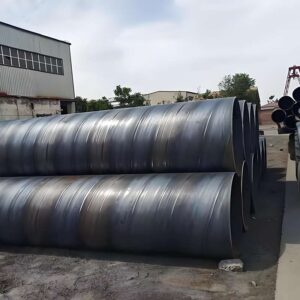
– SSAW (Spiral Submerged Arc Welded) Steel Pipe: Manufactured from steel coils, with the weld seam running helically along the pipe body.
LSAW pipes are commonly used in large-diameter, heavy-wall pipeline applications and pile foundation projects. SSAW pipes are widely used in water supply, drainage, water transmission pipelines, and steel pipe piling.
The appropriate choice depends on factors such as pipe diameter, wall thickness, design pressure, applicable standards, and specific project requirements.
2. What Are the Common Outside Diameter and Wall Thickness Ranges of LSAW Steel Pipes?
LSAW steel pipes are primarily used for medium- and large-diameter pipeline applications. Common outside diameters range from approximately 406 to 1,620 mm, with wall thicknesses typically ranging from 6 to 50 mm, depending on the manufacturer’s equipment and production capabilities.
When placing an order, specifying only the outside diameter and wall thickness is not sufficient. Buyers should also clearly indicate the pipe length, material grade, quantity, and dimensional tolerances.
For extra-large diameters, heavy wall thicknesses, or special pipe lengths, the manufacturer’s production capabilities should be confirmed in advance.
3. What Materials and Standards Are Commonly Used for LSAW Steel Pipes?
LSAW steel pipes can be manufactured using different material grades and product standards depending on their intended applications. Common options include:
| Applicable Standard | Common Steel Grades | Main Applications |
|---|---|---|
| API 5L | Grade B, X42, X52, X60, X65, X70 | Oil and natural gas transmission |
| ASTM A252 | Grade 1, Grade 2, Grade 3 | Steel pipe piles and foundation engineering |
| EN 10219 | S235JRH, S275J0H, S355J2H | Structural engineering |
| EN 10210 | S235JRH, S275J0H, S355J2H | Hot-finished structural hollow sections |
| GB/T 9711 | L245, L290, L360, L415, L450 | Oil and gas pipelines |
Different standards specify requirements for chemical composition, mechanical properties, manufacturing processes, and inspection procedures. Material selection should be based on the project design documents and procurement specifications. Steel grades should not be considered interchangeable solely because they have similar designations.
4. How Is the Weld Quality of LSAW Steel Pipes Inspected?
Weld quality directly affects the structural integrity and service safety of steel pipes. Common inspection methods include:
- UT (Ultrasonic Testing): Used to detect internal defects in weld seams.
- RT (Radiographic Testing): Uses radiographic imaging to examine the internal quality of weld seams.
- MT (Magnetic Particle Testing): Used to detect surface and near-surface defects in ferromagnetic materials.
- PT (Penetrant Testing): Used to detect surface-breaking defects in materials.
In addition, mechanical testing, hydrostatic testing, and dimensional inspection must be carried out in accordance with the applicable standards and project requirements.
The specific inspection methods, testing coverage, and acceptance criteria should be clearly defined in the purchase contract.
5. What Types of Anti-Corrosion Coatings Are Available for LSAW Steel Pipes?
LSAW steel pipes can be supplied with different anti-corrosion coating systems depending on the conveyed medium, burial environment, and service conditions.
Common coating types include:
- 3PE Coating: Primarily applied to the external surface of steel pipes, providing corrosion protection for buried pipelines.
- FBE Coating: Fusion-Bonded Epoxy coating, which can be applied to either the internal or external surface of steel pipes.
- Internal Epoxy Coating: Commonly used for water transmission pipelines to reduce corrosion on the internal pipe surface.
- Polyurethane Coating: Used for protective coatings or thermal insulation systems, depending on the specific coating system and service environment.
When selecting an anti-corrosion coating system, buyers should clearly specify the internal and external coating types, coating thickness, application standards, adhesion performance, and inspection requirements. Simply specifying a coating name such as 3PE or FBE is not sufficient.
6. What Information Should Be Provided to the Manufacturer When Purchasing LSAW Steel Pipes?
To obtain an accurate quotation and ensure that the supplied products meet project requirements, buyers are advised to provide the following information:
- Specifications: Outside diameter, wall thickness, and individual pipe length.
- Material: Steel grade and the corresponding product standard.
- Quantity: Total tonnage, total length in meters, or number of pieces.
- Manufacturing Requirements: Forming process and welding requirements, if specifically specified.
- Inspection Requirements: UT, RT, hydrostatic testing, and third-party inspection requirements.
- Anti-Corrosion Requirements: Internal and external coating types, coating thickness, and applicable standards.
- Delivery Requirements: Delivery location, packaging method, and required delivery time.
For engineering projects, buyers should also provide the Technical Specification and relevant drawings to avoid quotation discrepancies or potential quality disputes caused by unclear technical requirements.