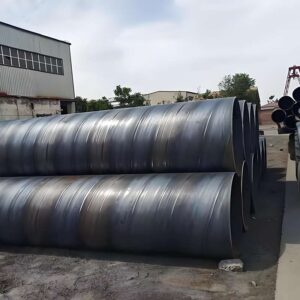
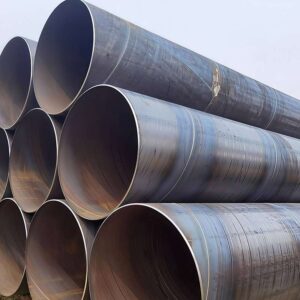
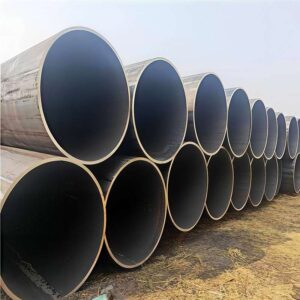
I. What Are Steel Pipe Piles and What Role Do They Play in Foundation Engineering?
In large-scale foundation projects, when the surface soil cannot provide sufficient bearing capacity to support a structure, deep foundations are often required to transfer the loads from the superstructure to deeper, more stable soil layers or bedrock. Steel pipe piles are one of the commonly used pile types in deep foundation engineering.
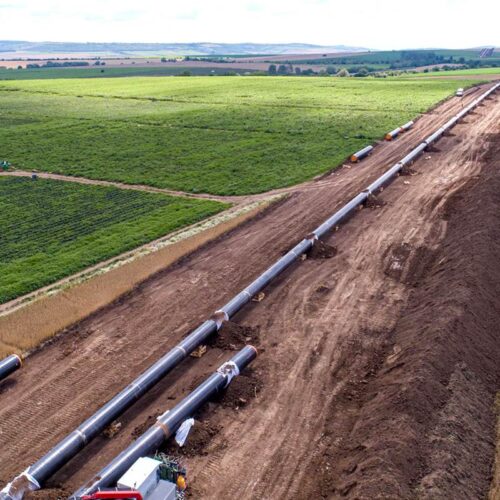
Steel pipe piles are foundation piles made primarily from steel pipes. They are installed underground or underwater using construction methods such as impact driving, vibratory driving, or drilling to form a supporting foundation structure. Depending on the engineering design, steel pipe piles can be used as hollow sections or filled with concrete after installation.
Compared with other types of piles, steel pipe piles offer several advantages, including a regular cross-sectional shape, customizable lengths and wall thicknesses, ease of welding for pile extensions, and adaptability to different construction conditions. As a result, they are widely used in marine terminals, bridges, ports, industrial facilities, and large building foundations.
i. How Do Steel Pipe Piles Carry Loads?
Steel pipe piles primarily carry foundation loads through two mechanisms:
1. Transferring Loads Through Friction Between the Pile Shaft and Surrounding Soil (Skin Friction)
- Once a steel pipe pile is driven into the ground, its outer surface comes into close contact with the surrounding soil. When the weight of a building or bridge is transferred to the pile, friction develops between the pile shaft and the surrounding soil, allowing part of the load to be transferred to the adjacent soil layers.
- Simply put, steel pipe piles support the superstructure by relying on friction between the pile shaft and the surrounding soil.
2. Transferring Loads Through Resistance at the Pile Tip (End Bearing)
- As the steel pipe pile is driven deeper into the ground until it reaches a soil layer or rock stratum with sufficient bearing capacity, the pile tip can obtain support from the firm ground beneath it.
- Simply put, this works much like placing a column on solid ground. The steel pipe pile transfers the weight of the superstructure to a firm soil layer or rock stratum through the resistance provided at its base.
3. In Addition to Vertical Loads, Steel Pipe Piles Must Also Resist Lateral Forces
- In bridge and marine terminal projects, steel pipe piles not only support the weight of bridges, platforms, and equipment but may also be subjected to lateral forces caused by water currents, waves, wind, and berthing vessels. These forces can cause bending in the pile. Therefore, the lateral load-bearing capacity and bending resistance of steel pipe piles must also be considered in the design of such projects.
ii. Common Steel Pipe Pile Configurations and Installation Methods
The structural configuration and installation method of steel pipe piles should be determined according to the project design requirements.
- Open-ended Steel Pipe Piles: The pile tip remains open, allowing soil to enter the pipe during driving. This type is suitable for various driven foundation applications. However, the formation of an internal soil plug and its effects on installation and load-bearing performance must be taken into account.
- Closed-ended Steel Pipe Piles: The pile tip is fitted with an end plate or a specially designed pile shoe. During installation, the pile displaces the surrounding soil.
- Concrete-filled Steel Pipe Piles: After the steel pipe is installed, concrete is placed inside the pipe according to the design requirements. In some designs, reinforcing steel is also provided to form a composite load-bearing structure.
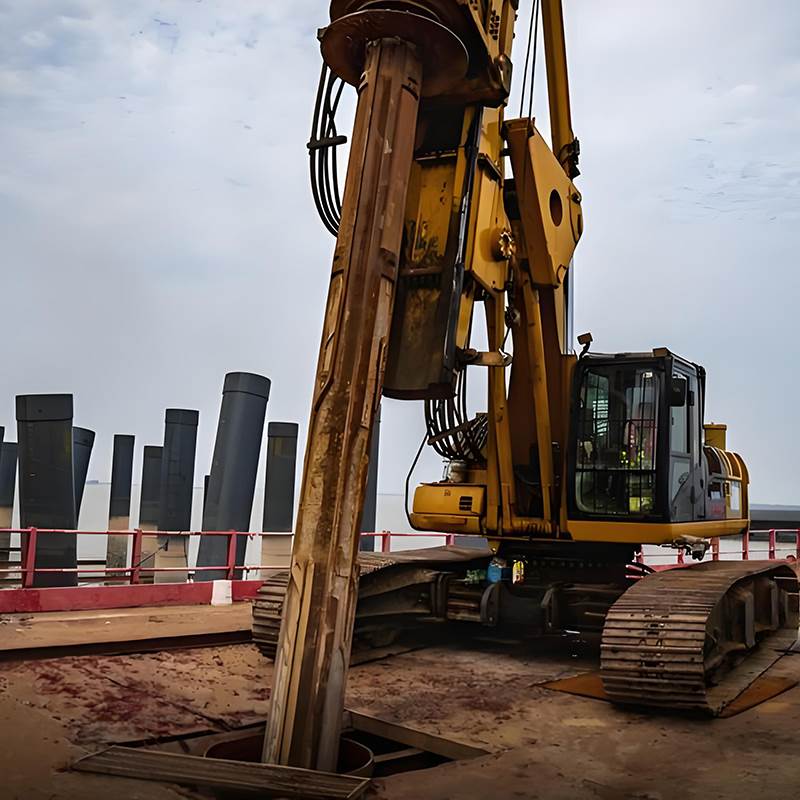
In terms of installation methods, common options include driven steel pipe piles and piles installed by placing steel pipes into pre-drilled holes.
It is important to distinguish between these two concepts: open-ended and closed-ended refer to the structural configuration of the pile tip, while driving and drilling refer to the installation methods. They should not be confused with each other.
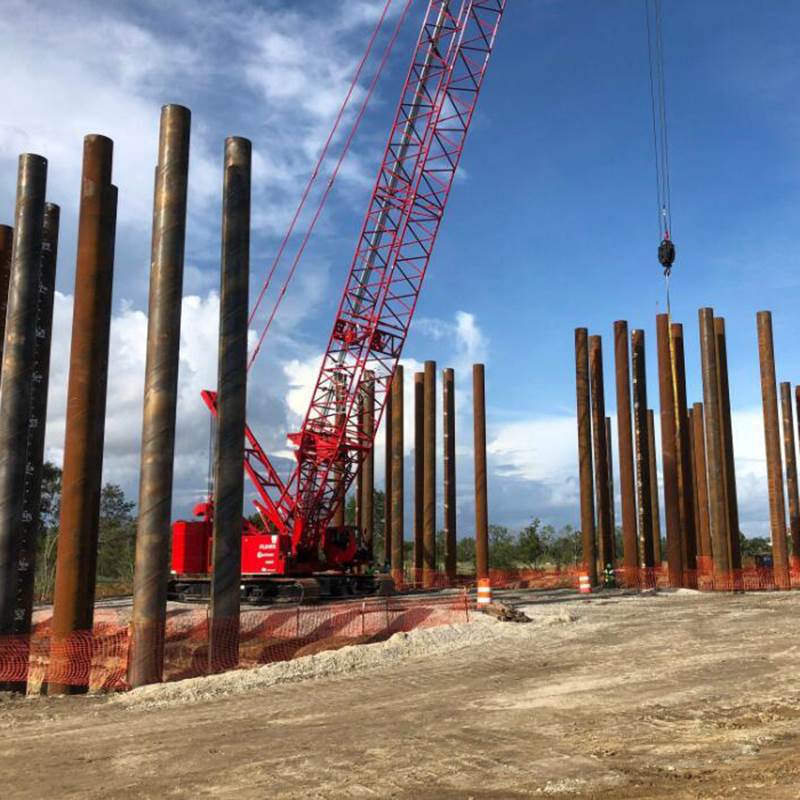
II. Applications of Steel Pipe Piles in Different Types of Projects
Different foundation projects have significantly different geological conditions, loading requirements, and construction environments. As a result, the roles and technical requirements of steel pipe piles vary from one project to another.
I. Marine Jetty Foundations
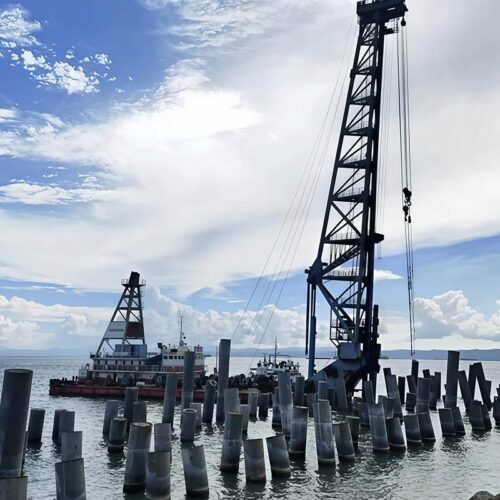
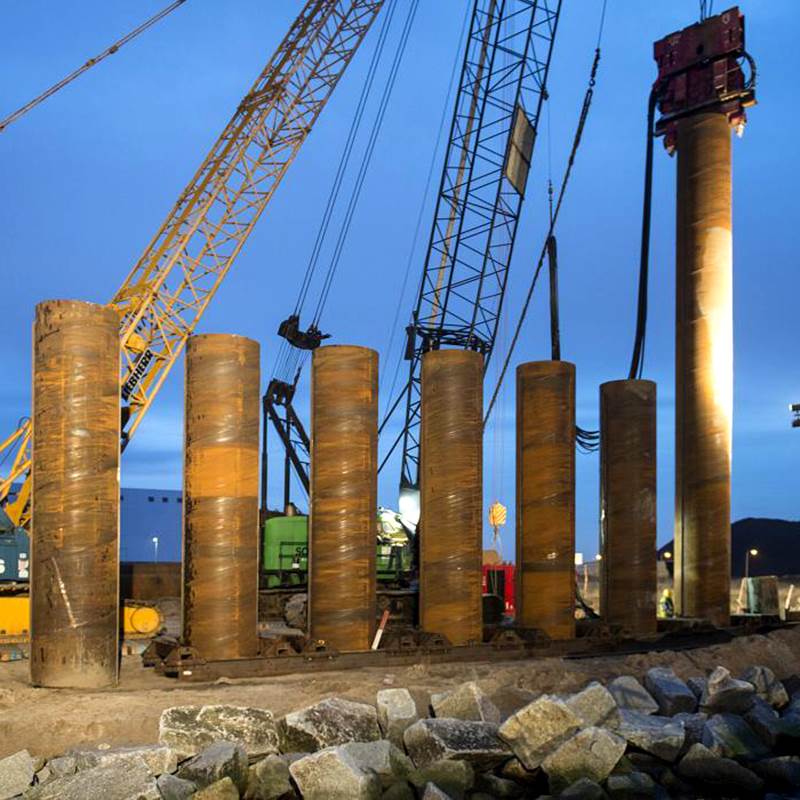
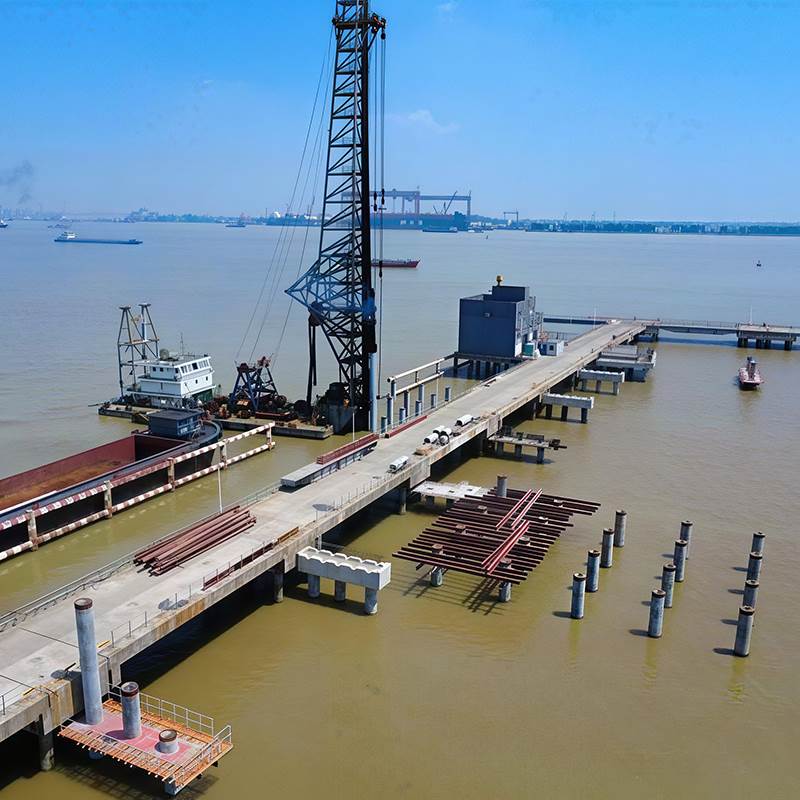
Marine jetties are typically constructed along coastlines, in offshore areas, or within harbors. Some structures extend out over the water and require pile foundations to support the jetty deck and associated facilities.
In these projects, steel pipe piles are typically arranged along the jetty deck and driven into the seabed to form a supporting foundation system. The pile tops are connected to beams, pile caps, or the superstructure’s steel framework to jointly support the deck, equipment, and operational loads.
Typical Applications of Steel Pipe Piles:
- Foundations for access trestles and offshore walkways.
- Foundations for offshore loading and unloading platforms.
- Support structures for marine terminal working platforms.
- Foundations for offshore construction platforms and related auxiliary facilities.
Why Are Steel Pipe Piles Used in Marine Jetty Projects?
First, marine jetties often need to extend across a certain water area, where the construction of conventional shallow foundations may face challenges due to water depth, soft soil conditions, and underwater excavation. Steel pipe piles can be driven into the seabed to form deep foundations, reducing the need for extensive underwater foundation excavation.
Second, marine jetties must support not only the self-weight of the deck but also loads from handling equipment, cargo storage, vessel berthing, and forces generated by waves and water currents. Steel pipe piles can be specified with suitable diameters, wall thicknesses, and lengths according to the design requirements to meet the structural loading demands.
What Are the Specific Requirements for Steel Pipe Piles in Marine Jetty Projects?
- Corrosion Protection: Exposure to seawater, marine atmospheres, and alternating wet and dry conditions in tidal zones increases the risk of steel corrosion. The corrosion protection system should be selected according to the actual exposure conditions of each area.
- Structural Strength: Steel pipes must meet the design requirements for axial loads, lateral loads, and bending moments.
- Welding Quality: For steel pipe piles that require field welding for extension, the welding procedures, weld inspection requirements, and joint strength specifications should be clearly defined.
- End Preparation: Depending on the pile-driving equipment and construction requirements, it should be determined whether the pipe ends need beveling, reinforcing rings, or specially designed pile shoes.
- Transportation and Lifting: Marine projects often involve long steel pipes. Factors such as the weight of each pipe, lifting positions, pipe-end protection, and marine shipping arrangements must be carefully considered.
It is particularly important to note that corrosion protection in marine environments should not be evaluated solely by the coating type or thickness. Consideration must also be given to whether the coating is susceptible to damage during pile driving and how any damage will be repaired after installation.
ii. Bridge Foundations
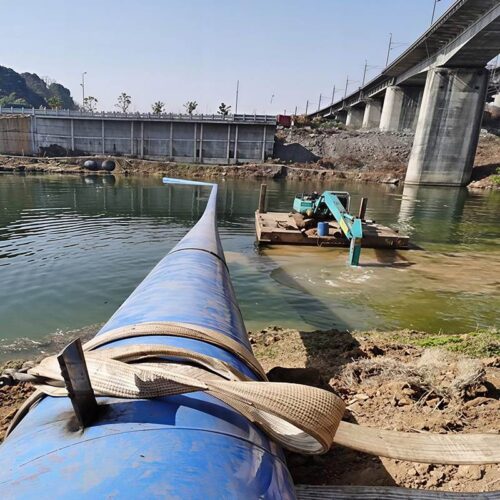
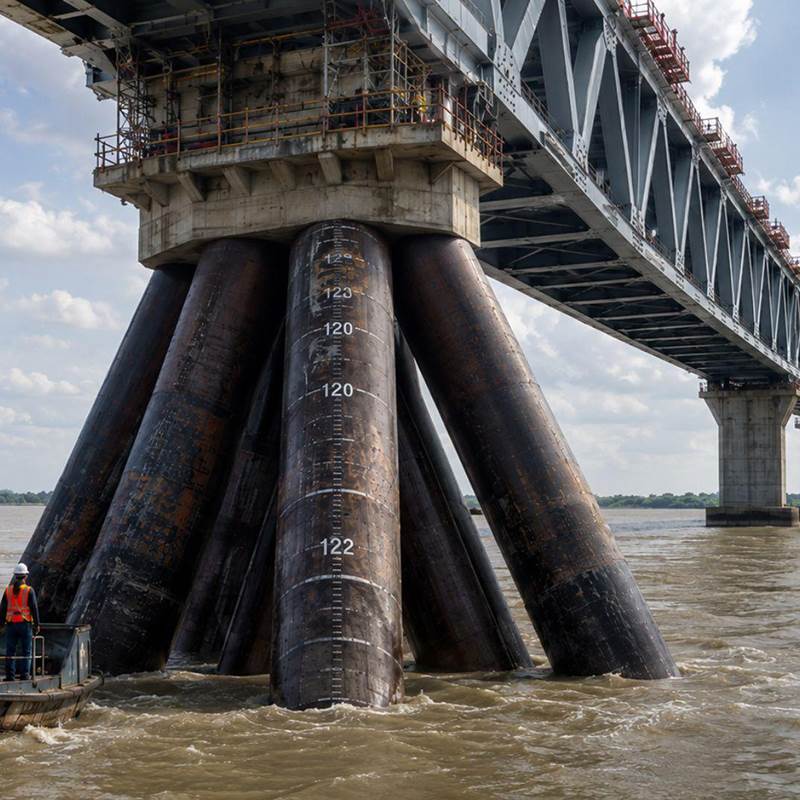
For river-crossing bridges, sea-crossing bridges, and bridges built on soft soil foundations, steel pipe piles can be used as foundation support members for substructures such as bridge piers and abutments.
Typical Applications of Steel Pipe Piles:
- Foundation piles for river bridge piers.
- Underwater foundations for sea-crossing bridges.
- Foundations for bridge abutments and approach bridges.
- Deep foundations for large-scale transportation infrastructure projects.
Why Are Steel Pipe Piles Used in Bridge Construction?
Taking river-crossing bridges as an example, the surface layers of a riverbed may consist of silt, loose sand, or other soils with relatively low bearing capacity. If shallow foundations are used directly, extensive excavation may be required, and controlling foundation settlement can be difficult.
Steel pipe piles can penetrate these softer surface soil layers and extend into deeper soil strata with sufficient bearing capacity. They transfer bridge loads through a combination of skin friction along the pile shaft and end bearing resistance at the pile tip.
In addition, bridge piers located in flowing water may be exposed to water forces, impacts from floating debris, and riverbed scour. Therefore, bridge pile foundations must not only meet vertical load-bearing requirements but also account for lateral forces and the effects of increased unsupported pile length caused by scour.
What Are the Specific Requirements for Steel Pipe Piles in Bridge Projects?
- Load-Bearing Capacity: The specifications and lengths of steel pipe piles should be determined based on the bridge design loads and geotechnical investigation data.
- Bending Resistance: For bridge pier foundations subjected to significant lateral loads, particular attention should be paid to the cross-sectional properties and wall thickness of the steel pipe piles.
- Scour Protection Design: The loading conditions of the pile foundation after scour should be evaluated based on the maximum anticipated scour depth of the riverbed.
- Pile Splice Quality: Long-distance underwater construction may require multiple sections of steel pipe to be joined together. All pile joints must meet the relevant design requirements.
- Construction Suitability: Pile-driving equipment and construction methods should be selected according to the riverbed geology, pile length, and actual site conditions.
For bridge projects, it should not be assumed that thicker steel pipes automatically result in safer foundations. The cross-sectional strength of the pipes, pile-soil interaction, pile length, and construction quality must all be considered together.
iii. Port Construction
Port projects typically include terminals, quay walls, loading and unloading platforms, storage yards, and other supporting infrastructure. Compared with conventional building foundations, port projects often face more complex conditions at the land-water interface and must accommodate heavier equipment loads.
Steel pipe piles can be used to provide foundation support for port terminal structures, pile-supported quay walls, loading and unloading platforms, and certain port-related facilities.
Typical Applications of Steel Pipe Piles:
- Foundations for container terminals.
- Foundations for bulk cargo terminals and loading and unloading platforms.
- Pile-supported quay walls.
- Foundations for port access trestles and equipment platforms.
What Role Do Steel Pipe Piles Play in Port Construction?
Taking a container terminal as an example, the terminal structure must not only support its own weight but also withstand loads generated by stacked containers, cargo-handling machinery, transport vehicles, and other operational equipment.
In pile-supported terminal structures, steel pipe piles are typically arranged beneath the deck at specified positions and spacing according to the engineering design. The pile tops are connected to the superstructure’s beam-and-slab system, transferring the loads to the underlying ground.
In some pile-supported quay wall projects, steel pipe piles can also serve as structural components of the quay wall. They may work together with other retaining or anchoring systems to ensure quay wall stability and control earth pressure.
What Are the Specific Requirements for Steel Pipe Piles in Port Projects?
- Large-Diameter and Heavy-Wall Specifications: The outside diameter and wall thickness should be determined based on equipment loads, terminal structural requirements, and geological conditions.
- Dimensional Accuracy: The outside diameter, wall thickness, length, roundness, and straightness of steel pipes must comply with the project’s technical specifications.
- Weld Quality: For piles subjected to significant loads, weld inspections should be carried out in accordance with the design specifications and contractual requirements.
- Corrosion Protection: Corrosion protection requirements should be determined according to exposure to seawater, tidal conditions, marine atmospheres, and underwater burial environments.
- Field Connections: The pile splice locations, connection types, welding procedures, and inspection requirements should be clearly specified.
It is important to distinguish between marine jetty foundations and port construction. Although these two applications overlap to some extent, they are not exactly the same. Marine jetty foundations focus more on supporting offshore or nearshore platforms, while port construction covers a broader range of port infrastructure and quay wall structures.
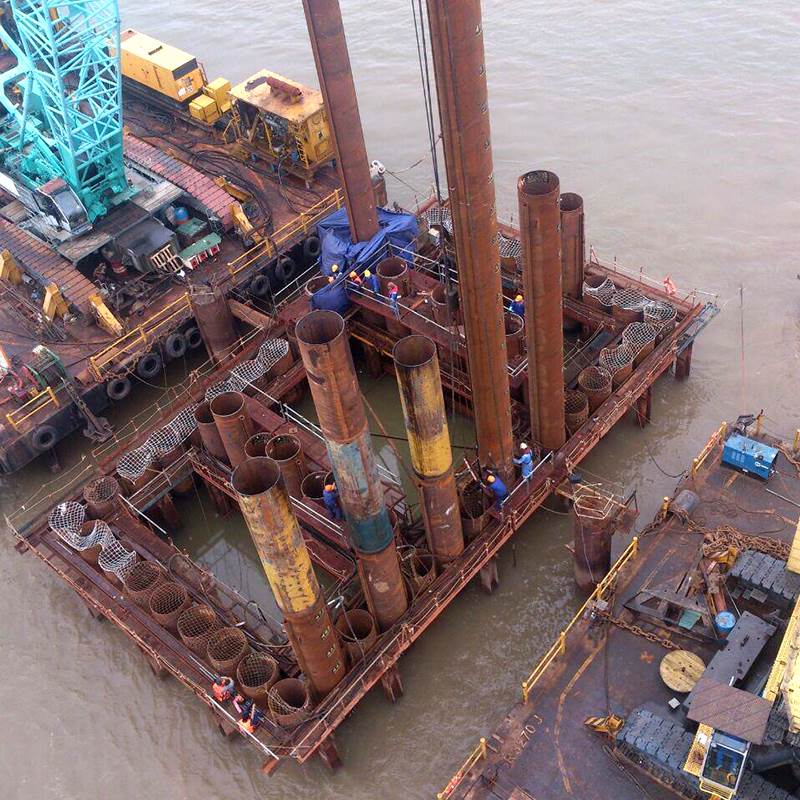
iv. Building Foundations
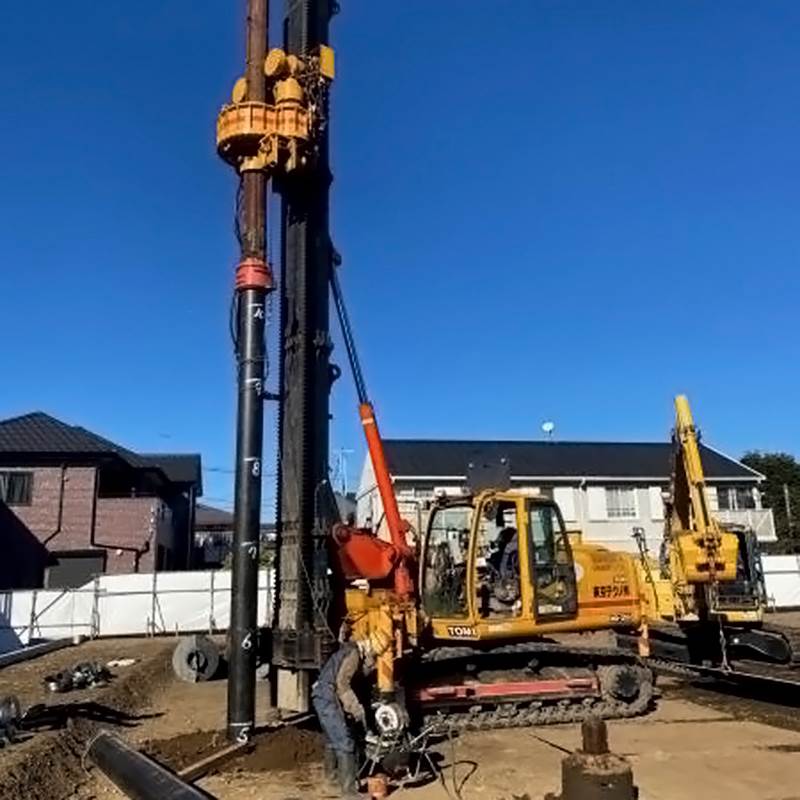
In building construction, pile foundations may be adopted when the surface soil has insufficient bearing capacity, when the building carries heavy loads, or when strict settlement control is required.
Steel pipe piles can be used in industrial buildings, large warehouses, high-rise buildings, and other construction projects that require deep foundation support.
Typical Applications of Steel Pipe Piles:
- Deep foundations for high-rise buildings.
- Foundations for industrial buildings.
- Foundations for large warehouses and logistics facilities.
- Foundations for heavy equipment.
- Other building foundations on soft soil.
Why Are Steel Pipe Piles Used in Building Projects?
For example, when constructing a large industrial building on soft soil, relying solely on the shallow soil layers to support the weight of the building and its equipment may result in insufficient bearing capacity or excessive settlement.
By using steel pipe piles, loads can be transferred to deeper soil layers, improving the bearing capacity and deformation performance of the foundation.
For large industrial equipment foundations, in addition to the weight of the equipment itself, vibrations, impacts, and other dynamic loads generated during operation must also be considered. The cross-sectional dimensions, pile spacing, and end-bearing conditions of steel pipe piles should all be determined in accordance with the equipment foundation design requirements.
What Are the Specific Requirements for Steel Pipe Piles in Building Foundation Projects?
- Pile Specifications: The outside diameter and wall thickness should be determined based on the building loads and geological conditions.
- Pile Length: The pile length should be determined according to the depth of the bearing stratum, required load-bearing capacity, and settlement requirements.
- Steel Properties: The steel must meet the design requirements for strength, toughness, and weldability.
- Pile Splicing Requirements: Whether the piles need to be joined in sections should be determined based on the capabilities of the construction equipment and the required pile length.
- Underground Corrosion Protection: The corrosion protection system should be selected according to groundwater conditions, soil pH, and other potential corrosive factors.
Building foundation projects differ from marine engineering projects, so corrosion protection systems designed for marine steel pipe piles should not be directly applied to underground foundations. The corrosivity of the surrounding soil and groundwater should be evaluated through site investigations and, where necessary, appropriate testing.
III. How do the requirements for steel pipe piles differ across various types of projects?
This table can help procurement personnel identify the key technical requirements to consider for different projects at an early stage. However, it should not be used as the sole basis for determining steel pipe specifications.
The main factors that actually determine steel pipe specifications include:
- Engineering design loads and the loading conditions of the pile foundation.
- Geotechnical investigation reports, including soil layer distribution, groundwater levels, and the depth of the bearing stratum.
- The pile foundation installation method and the capabilities of the construction equipment.
- The design service life of the steel pipe piles and the corrosion conditions of the surrounding environment.
- Applicable project design codes, material standards, and acceptance requirements.
Therefore, procurement personnel should first obtain the project design drawings and technical specifications, then confirm the manufacturer’s production and supply capabilities with the steel pipe supplier.
IV. What Technical Parameters Need to Be Specified When Purchasing Steel Pipe Piles?
For steel pipe buyers and engineering contractors, the most important question is not simply how much the steel pipes cost, but how to translate the engineering design requirements into clearly defined steel pipe procurement specifications.
i. Pipe Dimensions
Pipe dimensions directly affect the product weight, cross-sectional properties, suitability for installation, and transportation costs.
The following parameters need to be clearly specified:
- Outside Diameter (OD): The pipe diameter should be determined according to the engineering design.
- Wall Thickness (WT): The wall thickness should be determined based on structural strength, stability, and the loading requirements during installation.
- Pipe Length: The length of each pipe should be determined according to the designed pile length, construction equipment, and transportation conditions.
- Quantity: Specify the total number of steel pipes or the total required length.
For longer steel pipe piles, it is also necessary to confirm in advance whether they will be supplied in full-length sections or divided into multiple sections, as well as the proposed pile splicing method at the construction site.
For example, if the design requires each steel pipe to be 18 m long, production, transportation, or on-site lifting limitations may require the pipe to be supplied in two sections. In this case, the connection location and joint design must be confirmed in advance. The supplier should not decide how to divide the pipe into sections without prior agreement.
ii. Steel Grade
The steel grade determines the basic mechanical properties of the steel pipe and is an important parameter when purchasing steel pipe piles.
The following requirements need to be confirmed during procurement:
- Steel grade designation and applicable material standard.
- Yield Strength.
- Tensile Strength.
- Impact Toughness requirements, if specified by the project.
- Chemical composition and weldability requirements.
Different projects may adopt different material standards, such as ASTM, EN, API, or GB standards.
It is important to note that steel grades should not be directly substituted based on their designations alone. Even if two materials have similar yield strengths, their chemical compositions, toughness, through-thickness properties, and other requirements specified in the project specifications must also be checked.
iii. Manufacturing Process and Welding Requirements
Steel pipe piles can be manufactured using different production processes. The most common types include:
- SSAW Steel Pipe: Spiral Submerged Arc Welded Steel Pipe.
- LSAW Steel Pipe: Longitudinal Submerged Arc Welded Steel Pipe.
- Seamless Steel Pipe: Seamless Steel Pipe.
Each manufacturing process has its own production characteristics and range of applications. The specific type should be selected according to the design standard, pipe dimensions, wall thickness, welding requirements, and the manufacturer’s actual production capabilities.
For welded steel pipes, the following requirements should be given particular attention:
- Whether the welds comply with the applicable product standards and project technical specifications.
- Whether ultrasonic testing (UT) or radiographic testing (RT) is required.
- Whether hydrostatic testing or other specified inspections are required.
- Welding procedures and joint inspection requirements for pipe extensions.
It is particularly important to distinguish between the manufacturing welds of the steel pipe itself and the field welds used to connect individual pile sections during installation. These are two separate quality control processes, and the procurement technical documents should clearly specify the requirements for each.
iv. Corrosion Protection Requirements
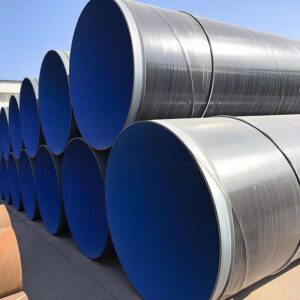
Steel pipe piles are often used for extended periods in underground, underwater, or exposed environments. Therefore, corrosion protection requirements should be determined according to the actual service conditions.
Common corrosion protection systems include:
- FBE Coating: Fusion-Bonded Epoxy Coating.
- 3LPE Coating: Three-Layer Polyethylene Coating.
- Other corrosion protection systems suitable for the project’s specific environmental conditions.
The following details should be clearly specified during procurement:
- Whether internal corrosion protection is required.
- Whether external corrosion protection is required.
- Coating type and specified thickness.
- Coating adhesion requirements and inspection criteria.
- Uncoated areas reserved at pipe ends and the repair method to be used after field welding.
One issue that is easily overlooked:
During pile driving, the external coating may be damaged by friction against the surrounding soil, contact with rocks, or construction equipment.
Therefore, it is not enough to consider only the coating inspection results obtained at the factory. Its suitability for the actual pile-driving process must also be taken into account. Where necessary, additional corrosion protection measures should be determined through engineering design, such as corrosion allowance, localized enhanced protection, or cathodic protection.
v. Pipe Ends and Connection Requirements
The end configuration of steel pipe piles directly affects on-site installation and connection.
The following details should be confirmed before procurement:
- Plain End: A flat, unprepared pipe end.
- Beveled End: A pipe end prepared with a bevel for welding.
- Closed End: A sealed pipe end.
- Pile Shoe: A specially designed shoe or tip fitted to the end of the pile.
- Reinforcing Rings or Other Special Connection Structures: As required by the engineering design.
If steel pipe piles need to be extended through field welding, the bevel configuration, welding procedures, connection locations, and non-destructive testing (NDT) requirements should be determined in advance.
For open-ended or closed-ended piles, it is also necessary to confirm that the pipe-end configuration is compatible with the pile-driving equipment and the overall engineering design.
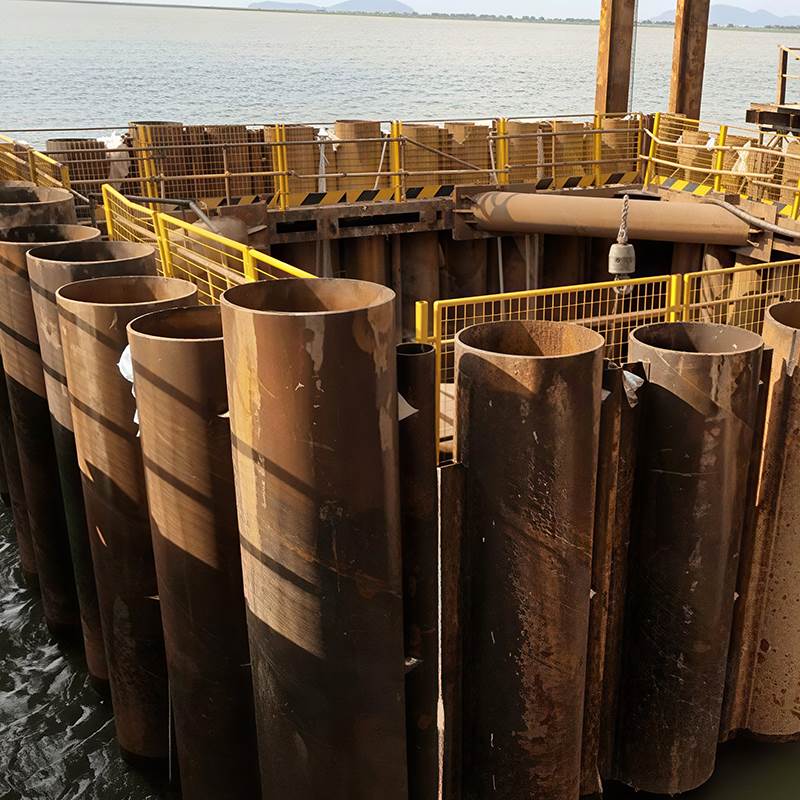
V. What Should Be Considered in Steel Pipe Pile Manufacturing and Quality Inspection?
For steel pipe pile procurement projects, in addition to confirming dimensions and material specifications, it is also important to pay attention to quality control throughout the entire production process, from raw materials to finished products.
This is particularly important for large-scale projects, where steel pipe piles are often required in large quantities and each pipe can weigh several tons. Any product quality issue may affect the on-site construction schedule and even require transportation and installation arrangements to be rescheduled.
Procurement personnel are advised to pay particular attention to the following inspection items.
i. Raw Material Quality Certificates
Before steel pipe production begins, the material quality certificates for the steel coils or steel plates should be checked and verified.
The main items to be checked include:
- Steel grade.
- Heat number or material batch number.
- Chemical composition.
- Mechanical properties.
- Applicable material standard.
The raw material batch information should be properly linked to the production records in accordance with the factory’s quality traceability system.
ii. Steel Pipe Dimensional Inspection
Finished steel pipes should be inspected in accordance with the project requirements. The main inspection items include:
- Outside diameter.
- Wall thickness.
- Length.
- Roundness.
- Straightness.
- Pipe-end dimensions and bevel preparation.
Roundness and straightness are particularly important for long steel pipe piles. Excessive pipe deformation may affect field splicing, installation, and construction accuracy.
iii. Weld Quality Inspection
For welded steel pipes, weld quality inspections should be carried out in accordance with the applicable product standards and project requirements.
Common inspection methods include:
- Visual inspection of welds.
- Ultrasonic Testing (UT).
- Radiographic Testing (RT).
- Other specified non-destructive testing (NDT) methods.
Different inspection methods have different scopes of application. A higher inspection percentage does not necessarily mean that the project requirements are fully satisfied. The final inspection requirements should always be based on the contract and technical specifications.
iv. Corrosion Protection Quality Inspection
For corrosion-protected steel pipe piles, the following items should also be inspected:
- Coating appearance.
- Coating thickness.
- Coating continuity.
- Adhesion and other specified performance requirements.
- Uncoated areas at pipe ends and the quality of coating repairs.
During lifting, transportation, and on-site unloading, appropriate protective measures should also be taken to prevent mechanical damage to the coating.
v. Quality Documentation and Product Traceability
When placing an order, it is recommended to specify that the supplier provide quality documentation relevant to the project, such as:
| Document Name | Main Purpose |
|---|---|
| Mill Test Certificate (MTC) | Certifies the chemical composition and mechanical properties of the steel material and product. |
| Dimensional Inspection Report | Records the dimensional inspection results of the steel pipes. |
| NDT Report | Records the results of non-destructive testing. |
| Coating Inspection Report | Records the inspection results of the corrosion protection coating. |
| Final Inspection Report | Summarizes the final inspection results of the finished products. |
| Packing List | Records the specifications, quantities, and weights of the products shipped. |
For bulk procurement projects, it is also important to confirm that pipe markings, production records, inspection records, and quality documents can be properly linked and traced to one another.
This helps prevent issues during on-site receipt, such as difficulties verifying pipe specifications, material batch numbers, or inspection records.
It should be noted that the documents listed above are common types of quality documentation, and not all of them are necessarily required for every project. The actual documentation to be provided should be agreed upon in the purchase contract and project quality plan.
VI. How to Select the Right Steel Pipe Piles for an Engineering Project
Selecting steel pipe piles should not be based solely on the type of project, nor should it be determined simply by the outside diameter and wall thickness. For actual procurement projects, the following steps are recommended.
Step 1: Understand the Ground Conditions
- Obtain the project’s geotechnical investigation report and review the soil profile, groundwater level, depth of the bearing stratum, soil corrosivity, and other relevant information.
- These factors determine the ground conditions that need to be considered in foundation design and also influence the required pile length and installation method.
Step 2: Confirm the Pile Foundation Design Requirements
- Based on the engineering drawings and design specifications, confirm the design load, pile diameter, wall thickness, pile length, pile toe configuration, and connection method.
- If the project involves lateral loads, bending moments, or significant dynamic loads, the corresponding structural design requirements should also be clearly defined.
Step 3: Confirm the Steel Pipe Manufacturing Requirements
Translate the design requirements into a technical specification for steel pipe procurement, clearly specifying:
- Steel pipe manufacturing standard.
- Steel grade.
- Outside diameter, wall thickness, and length.
- Weld quality and inspection requirements.
- Pipe end preparation requirements.
- Corrosion protection system and inspection standards.
Step 4: Evaluate Installation and Transportation Conditions
- Confirm whether the steel pipes need to be supplied in sections and welded on-site, and whether the available construction equipment can accommodate the required pipe lengths and weights.
- For export projects, transportation, lifting, and unloading conditions at the destination port should also be included in the supply plan.
Step 5: Confirm Quality Documentation and Acceptance Requirements
- Before signing the contract, clearly define the requirements for material certificates, dimensional inspection, non-destructive testing, coating inspection, and final acceptance documentation.
- If third-party inspection is required for the project, the inspection agency, scope of inspection, and acceptance criteria should also be confirmed in advance.
Following these steps can help minimize discrepancies between design requirements and the actual procured products, reducing the risk of problems during manufacturing, transportation, and on-site construction.